
How to Create Conditions for Higher Productivity
BY SIDHARTA CHATTERJEE
February 12, 2026

Productivity arises not just from effort, but from the nature of intentions, choices, and actions we choose. Let’s breakdown, explore, and analyse to reflect on what this could mean and how we can create optimal conditions that promote higher productivity among the workforce.
It would be futile to reduce productivity just to mere output, for it is something more than that. It is not just metrics, and to go beyond the traditional definition of productivity, we must understand it with clarity and purpose. The simple definition—how much is done in how little time utilizing a fixed amount of human and capital resources is inadequate to understand its true metaphysical underpinnings. Productive, in essence, isn’t just about the volume of actions or output; it’s alignment of productive efforts to aims, goals and objectives. To reflect more deeply, we may ask, “how much am I doing?”, or “How much more I can do in a better way?” through “Am I doing the right things?” to “What conditions can augment my productivity level?”
The goal is to align effort with strategic goals. The purpose is to align actions with corporate objectives. For this, what’s required? Alignment of human behavior with organisational/corporate values. Businesses create values. Values are intangible assets for the businesses. Corporate leadership must ensure efficient actions and doing the right things at the right time with right amount of resources. This is called streamlining. Hence, corporates must be efficient in executing priorities. Hence, it necessitates strategic prioritisation of tasks and objectives. To ensure higher productivity, and to perform at a higher level, strategic thinking alongside capability building are essential elements of effective corporate leadership and governance. It ensures long-term growth.
A cognitive-noetic space must be created for effective execution of sustainable actions to obtain quality outcomes. It is quality outcomes which matter.
The true fight boils down to efficiency and effectiveness—which according to Peter Drucker,
“Efficiency is doing things right. Effectiveness is doing the right things.”
Choose Your Actions Wisely: Intentional over Impulsive
Reactive Actions: Some actions are not programmed, meaning that we do them without asking if they are useful or not, or if those are the best uses of our time. These are not goal-oriented actions by which we aspire to achieve something.
- Guided Actions: Actions guided by clarity of purpose, meaningful actions through which we achieve our goals and objectives.
- Urgent Actions: The Eisenhower Matrix differentiates between urgent and important actions, meaning that not all urgent actions are not important.
- Important Actions: Improvement in productivity occurs when we focus on making important but not urgent actions. This is a part of decision-making framework. We should focus on long-term actions, set long-term goals and approach those goals with constructive actions.
Productivity improves when our actions are planned and programed ahead according to goals and objectives being set.
The Conditions that Shape Productivity
Different conditions boost our productivity levels. Actions guided by mental clarity and emotional stability have better outcomes. It is necessary to create a noetic space (mental space) for reflective, cogitative, and contemplative conditions by simply organizing tasks and planning ahead the best and worst outcome scenarios.
Without mental clarity, productivity suffers due to clumsiness, and we fall prey to easy and habitual actions. We must evaluate the value of what we are doing: evaluate what’s worth doing and discard useless activities that lead to waste of time, resources, and opportunities.
Patience and calmness expand possibilities.
The Work Environment: The surrounding ambience must be supportive enough to allow deep work, deep thinking, and deep work. We should gain control over distractions, noise, interruptions, to improve the quality of our actions. Actions lead to outcomes—and the quality of our actions determine the quality of outcomes that will determine the quality of results.
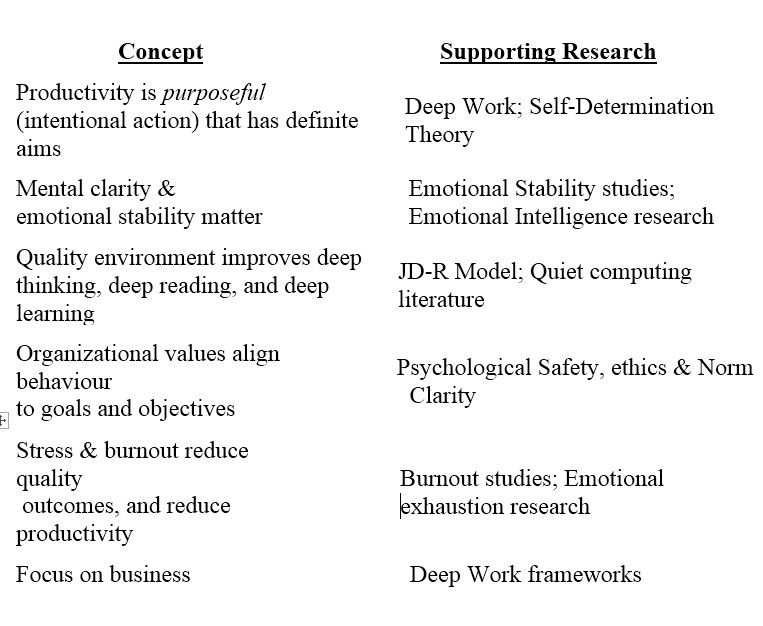
Energy and power are the foundations of productivity and success. Energy breeds discipline and focus. I am speaking about both mental and physical energy. Similarly, reflection is a metacognitive power. All you have to do is to step outside the boundary which you’ve set; find a new stream of action that leads to more productivity. Set values and check whether your actions are aligned with values. Ask questions like, am I moving closer to my set goals and objectives? Am I doing something meaningful? What am I avoiding? Hard work? These will bring you to the forefront of reflective path to higher, metacognitive understanding of your activities.
Energy is the base of productivity. Without energy, clarity fails. Reflection being a meta-cognitive power, it requires the power of thinking. But productivity is conditional as leaders shape the conditions necessary for optimal production of value-based, result-oriented, meaningful activities; e.g., goods and services.
These are the times of doing less to do more to achieve more. Often, simplicity leads to good results. Avoid making impulsive choices. Choose your options and make informed, productive choices that yield something fruitful. Try to do what matters, not by attempting to do everything.
Conclusion:
Conscious, deliberate actions lead to higher productivity. Create right conditions and do the needful. The right conditions are grounded on mental, emotional noetic, physical, and often moral—or ethical factors. Adoption productivity as a practice, not as a competition. Align it to your life and living to give it a healthy, productive meaning.
References:
- Singla, A. (2024). Psychological factors in workplace productivity and employee well-being. Shodh Sagar Journal of Inspiration and Psychology, 1(1), 21-25.
- Newport, C. (2016). Deep work: Rules for focused success in a distracted world. Hachette UK.
- Weichbroth, P., Lotysz, M., & Wrobel, M. (2025). A survey on the impact of emotions on the productivity among software developers. arXiv preprint arXiv:2510.04611.
- Chatterjee, S. (2025). Conditions for Productivity: Reflections on the Choice of Actions. Preprint server.
- Deci, E. L., & Ryan, R. M. (2012). Self-determination theory. Handbook of theories of social psychology, 1(20), 416-436.
- Dmytryshyn, M., & Goran, T. (2022). Proposal of an effective time management system. Management: Journal of Contemporary Management Issues, 27(2), 283-298.
- Syverson, C. (2011). What determines productivity?. Journal of Economic literature, 49(2), 326-365.