By SIDHARTA CHATTERJEE
February 20, 2026
Introduction
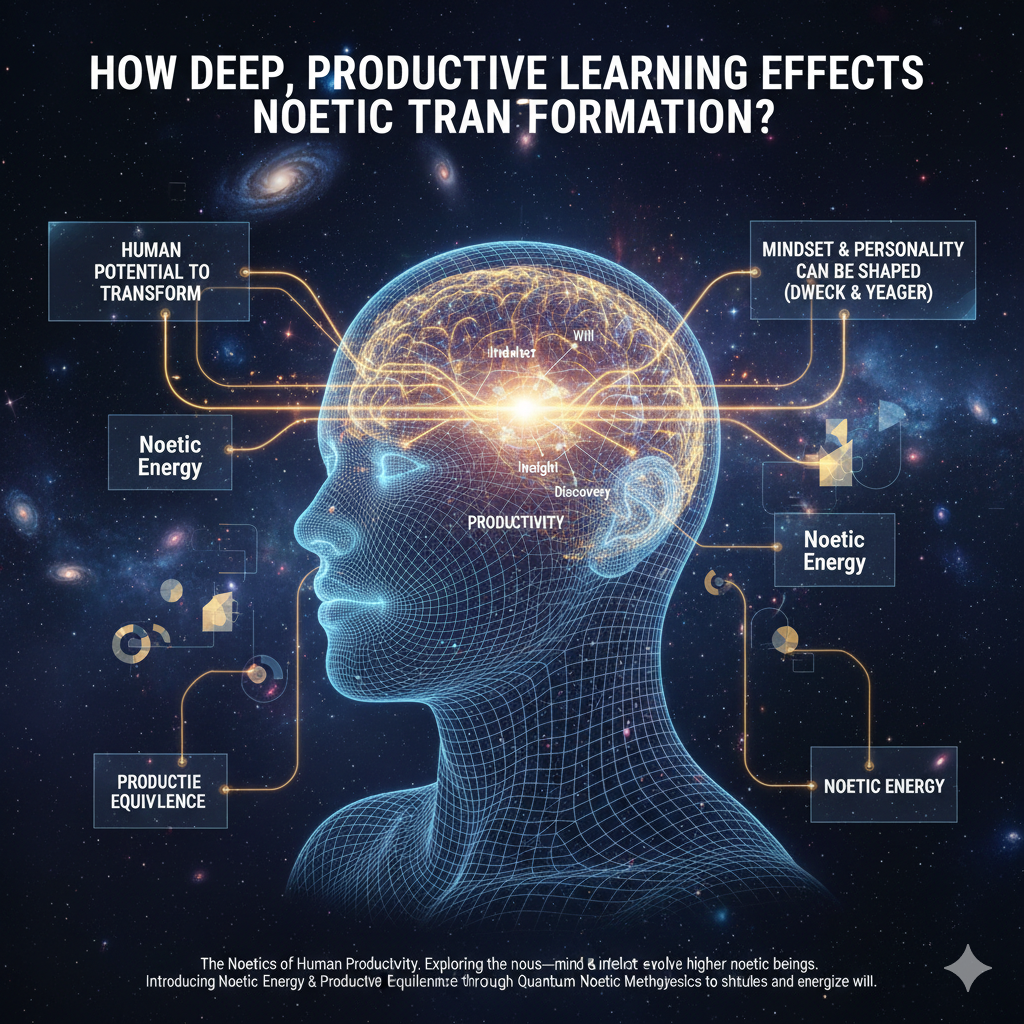
According to Dweck & Yeager (2019), people’s belief about mindset and personality are often limited to crude opinions. The authors believe that particular attributes like intelligence and personality are not fixed, but can be shaped and developed. Many forerunners of learning also believed that humans have the ability to transform themselves. And it has been proved true that this is not just a belief, but a fact supported by numerous instances and examples.
The Noetics of Human Productivity
The science of human potentiality is an interesting avenue to unfold great many secrets about human productive potential. And we follow this subject matter with great enthusiasm to explore and introduce novel concepts related to the nous—the mind and the intellect, to reveal new secrets that might help individuals evolve into higher noetic beings, grow and evolve into more productive personalities. For this purpose, we introduce some novel concepts that noetic energy and productive equivalence, and explain in the light of quantum noetic metaphysics how they might actually relate to human potential frontier. By noetic energy, it is denoted here the intellectual forces helping shape our productive attitudes which energise our will to become more proactive.
To derive noetic energy from a productive body of wisdom, i.e., philosophy, literature or science, and to determine the influence of it on the learning minds, deep study has a high utility. Individuals who are closer to or within the field of action, e.g. reading, learning, and training develop higher noetic capabilities going forward. This is a universal truth which is accepted without doubt. Theories of productivity, on the other hand, those derived from the general postulates of organisational operation, culture and practice are grounded on the notion of productive equivalence. This notion is derived from the study of Nida & Taber, (1982). It simply paves the way for translation of most relevant messages on the target audience to inspire higher productivity through communication of productive wisdom, as it focuses on meaning and effect.
This is also the reason for a common advise widely circulated that one who’s closer to a highly productive field encounters the forces of productivity who’s able to acquire more productive energy in far better manner than those who are significantly removed from it. Deep learning contributes to this phenomenon as well.
The productive effects of deep learning and deep actions can be explained by means of the theory of productive equivalence. This is not an assumed hypothesis; it can be plainly deduced from repeated observations on productivity on the basis of deductions made from practice.
It is important to understand the methods of deep learning that leads to higher productivity, if it be the case which calls for the validation of such methods in question. To confirm such deductions drawn from the theory of productivity, we set some examples to see how the theory aligns with practice. We may call it the theory of deductive practice of productivity.
Practical Notions for Productivity
Productive inducements for success are triggered by observing others succeed—since success requires productivity and action. The urges to act and become highly productive is an instinct—often triggered by words and its many forms orchestrated through speech or writings. There may be many other motives for productivity beyond these means—since the will to productive action is contingent upon encouragements, urges, and actions performed by others from motives other than profit seeking alone. Although these might not align nor be in congruence to Skinner’s (1953) thoughts on human behavior, who earlier proposed the principles of operant conditioning that reflects ideas derived from observable behaviors—and not reliant on will, mind or personality, the latter mental phenomena are gaining some grounds these days owing to the limitations posed by “radical behaviourism” as a tool for studying personality traits in these evolving times. It is for the reason that cognitive processes are real and the evolution of cognitive psychology directly challenges radical behaviourism. Based on these grounds, we propose a more Avant-garde theory relating human noetic potential to the development of higher productive capabilities. However, Skinner’s behavioral postulates are still relevant today in the context of observable behavioral traits from which deductions can be made regarding practical interpretations of insights as productive behavioral interpretations.
In practice, people who adopt productive habits that have value do more than those who do less without avoiding or desisting from unproductive activities. It depends—largely, to adoption of habits that transform individuals into highly proactive beings. Hence, it is always advisable to base your actions upon concrete theories of productivity having higher general utility. This is one of the practical notions of productivity. It also relies—to a great extent—on the development of “rational habits” that have real value, and that which make them more productive.
History and human perception have taught us how to observe and understand the behaviors of highly successful individuals, for the reason of emulating such behaviors and for the purpose of adopting some of the productive habits of others that have already contributed to higher achievements. But what need be observed more closely is the mechanism of co-ordination of learning behavior of highly successful individuals who demonstrate higher levels of productivity in practice. It would benefit people to correctly interpret productive behaviors and attitudes of others which may aid productive transformation of the mind. We call this change noetic transformation. But emulation isn’t the exact stuff we are interested with. We stress more on the original behaviors that fit the contexts, and which greatly influence the outcomes of actions.
It is by means of a well-co-ordinated deep learning process we can help unlock untapped potential in order to take human productivity to such a level which has never been achieved before. Here, the application of the general laws of productivity and productive learning comes into the ambit of a productive field in question.
The productive field should be considered as of a special kind accommodating the postulates of organisational productivity based on which laws can be formulated upon observing the consistent behaviors common to highly productive individuals, who have attained highest levels of success. Such productive behaviors can be readily formulated into laws determining success or failure. It also calls into question the importance of “productive energy” of individuals in effecting success.
The motto is to gain productive energies from deep, consistent, power reading of powerful books on productivity and philosophy which must be accompanied by continuous learning to know more about how such principles of productive learning influence people in action.
Prompts of Productive Motivations
There are individuals who proceed towards higher productivity all by their own decisions. Whereas, others are either motivated or enticed, or out of necessity they do things for themselves and others. Productive human potential in business and corporate organisations often exhibit extraordinary effects in the form of turnaround strategies that change things around in a favorable direction. This may also result from prompts: “inducements” to higher productivity of employees.
Motivation doesn’t merely consists of words and its many forms: what inspires individuals to action may be a very many factors including motives for action with a higher probability of positive outcomes tied to it. Individuals, from time immemorial, have become known and celebrated for their great thinking and actions; i.e., for their productivity. Today, productivity is the fundamental basis of almost all organisational and business decisions. It would be unwise to expect outcomes (results) without productivity, where efficiency and skills (abilities) are tied to the outcomes of productivity.
Businesses don’t base their actions and decisions upon blank hypotheses. They always avoid taking unproductive decisions that yield nothing. They encourage performance of productive actions among their employees, since their profits are driven by the power of productive performances. Hence, organisational actions must be performed from the perspective productive motives. However, organisational actions are often exceedingly difficult as they are experts in solving problem, which require experts who are able to withstand difficult conditions and face contexts that are cognitively challenging. Hence, Bjork & Bjork (2011), in their research, promotes creation of desirable difficulties to support deep cognitive engagements over passive exposure. Such difficulties and challenges create new productive dimensions for firms and their workforces.
Most organisational decisions are grounded on value creation: innovations, improvements, and advancements. The goal is to inspire productivity among the workers. Hence, actions prompted by productive motives have better outcomes than those that are not. Business—as a rule, do not subscribe to useless valuations. The immense effects of productive decisions with positive outcomes are abound in today’s contexts. The productive decisions of the most powerful individuals are live examples of such practice. Therefore, it is necessary to grow rational productive habits that exhibit rational appearances of actions and their outcomes. As a result, the reason to oppose an action deemed unproductive and useless merits consideration.
But how all these relate to noetic transformations?
Noetic transformation occurs from deep engagement in learning activities that encompass deep reading and analysis of information hence acquired. The concept of deep learning has been proposed by many, the pioneering among them being Ohlsson (2011), Sejnowski (2018), and others in most recent times. In this context, deep thought (Baehr, 2022) and deep thinking, too, are much relevant to what we aspire to investigate and study concerning human productive potential.
Precise selection should be made about selecting power books that can genuinely help boost productivity. For some people, deep learning has become a habit. The role of reinforcement learning is much relevant in this context, as it helps the mind get deeply engaged to continuous learning (Goel et. al., 2025). Here, time is a constraining factor, so, a precise selection of the most relevant reading materials is of utmost importance to the learner.
In fact, mapping cognitive behaviors of exceptional and brilliant learners have revealed startling secrets about how deep learning effects cognitive transformations (See, for example, Brown et. al. (2014), Carey (2015), and Roediger & Karpicke (2006)).
Selective reading of highly effective books can provide deep insights about the subject matter, which also generates a strong noetic field of productivity grounded on productive reading, which serves the purpose well. It also reinforces the role of deliberate practice of reading and re-reading to nurture expertise, and hence, improve performance (see Ericsson et. al., (1993)). As a consequence, it breeds the habit and culture of deep work Newport, (2016).
Our theoretical research, therefore, comes to the aid in solving this problem of managing time for effective re-reading, which also provides the necessary noetic nourishment to the mind. Through these means, we are developing a novel framework for the mind and the intellect to allow a metaphysical understanding of human productive potential in the light of quantum noetics.
Conclusion
It is always advisable to have goals to feel productive and become goal-oriented by means of which it is possible to attain higher success. There may be many inducements to productive actions, but it is important to know how and when the decisions become motives for action. Productive decisions are generally founded on the wisdom of action—and these are reinforced through continuous and persistent practice of learning. We follow this notion by wisdom of practice as the basis of productive decision-making that creates value. Whether we adopt principles of biomimetic intelligence or take aid of Artificial Intelligence, any real work need to be initiated and followed up by the human mind. By various means, we are able to acquire the ability to do more, but the techniques reinforcing the mind and nourishing the intellect are the front-runners of all that should base productivity, and the actions which should be based on productive motives. Valuing productive learning, hence, is the key factor contributing towards an inclusive noetic transformation. It would also help take human productive potential to a new level—to new great heights—through learning anew.
References:
- Baehr, J. (2022). Deep in thought: A practical guide to teaching for intellectual virtues. Harvard Education Press.
- Bjork, R. A., & Bjork, E. L. (2011). Making things hard on yourself, but in a good way: Creating desirable difficulties. Psychology and the Real World.
- Brown, P. C., Roediger III, H. L., & McDaniel, M. A. (2014). Make it stick: The science of successful learning. Harvard University Press.
- Carey, B. (2015). How we learn: The surprising truth about when, where, and why it happens. Random House Trade Paperbacks.
- Dweck, C. S., & Yeager, D. S. (2019). Mindsets: A view from two eras. Perspectives on Psychological science, 14(3), 481-496.
- Ericsson, K. A., Krampe, R. T., & Tesch-Römer, C. (1993). The role of deliberate practice in the acquisition of expert performance. Psychological Review.
- Goyal, R., Gupta, G., Gupta, S., Kakar, J. K., Singla, P., & Kaur, S. (2025, June). Enhancing Employee Productivity Prediction through Self-Supervised Learning and Reinforcement Learning. In 2025 International Conference on Computing Technologies (ICOCT) (pp. 1-6). IEEE.
- Newport, C. (2016). Deep work: Rules for focused success in a distracted world. Hachette UK.
- Nida, E. A., & Taber, C. R. (Eds.). (1982). The theory and practice of translation (Vol. 8). Brill Archive.
- Ohlsson, S. (2011). Deep learning: How the mind overrides experience. Cambridge University Press.
- Sejnowski, T. J. (2018). The deep learning revolution. MIT press.
- Skinner, B. F. (1953). Science and Human Behavior.