By SIDHARTA CHATTERJEE
February 11, 2026
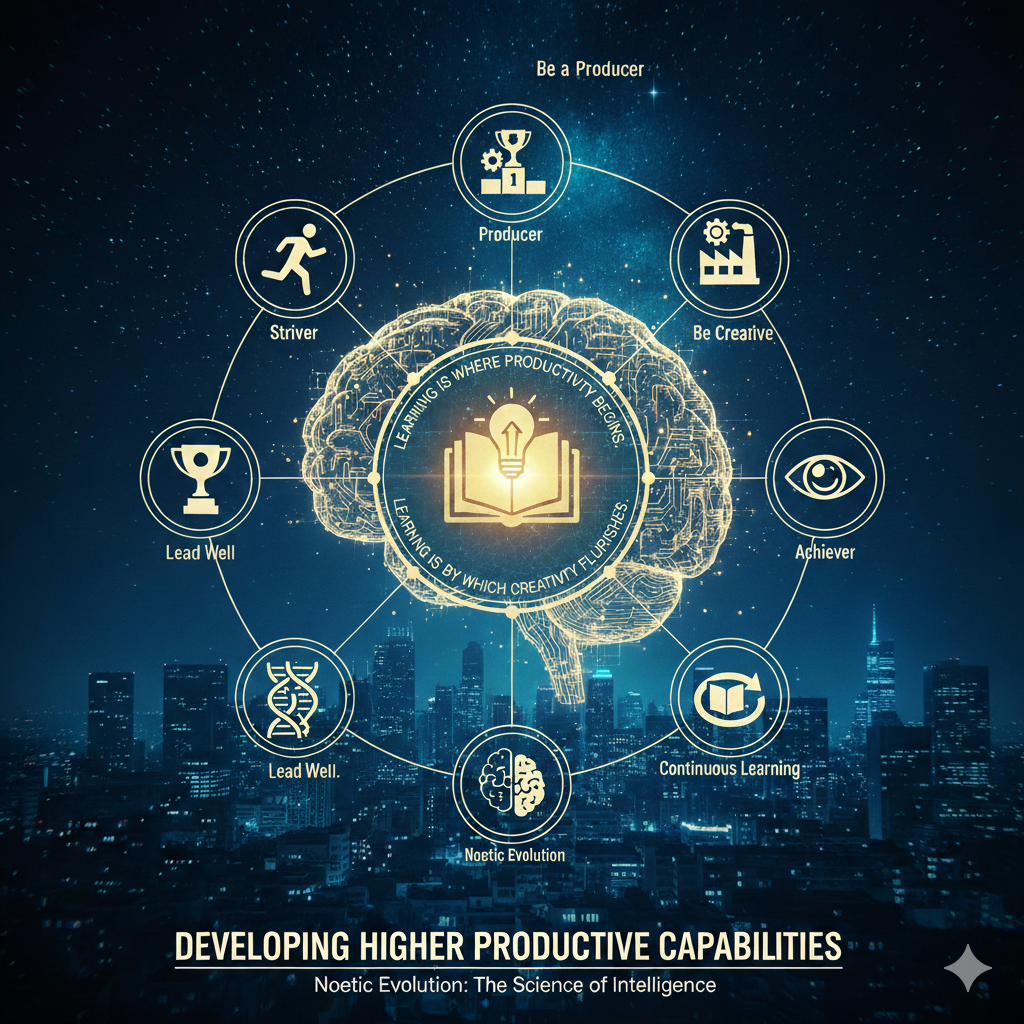
Be a striver, producer, and an achiever. But first, be a learner. Learn how to read well. Read to learn well. Be consistent in your practice of learning.
We all want to be achievers. We want to produce, to succeed, to make an impact.
But before we become producers, we must become learners. We must learn how to produce and become creative. Productivity is often viewed as an outcome of success, but in reality, it is one of its strongest enablers. At the heart of productivity lies continuous learning—the disciplined pursuit of knowledge, skill, and improvement. Improvement leads to noetic evolution of the mind. I am talking about the science of intelligence—noetics.
“Learning is where productivity begins. Learning is by which creativity flourishes.“
Before becoming achievers and producers, individuals must first become learners. Reading well, learning deeply, and practicing consistently establish the foundation for productive behavior. Consistency in learning builds discipline, and discipline drives sustained performance.
When we learn how to read well—when we read with purpose—we don’t just gather information. We build discipline. A disciplined learner can achieve success in any field. Discipline is the backbone of productivity.
- Continuous learning is the cornerstone of higher productive capability. We are talking of higher productivity. Productivity is an augmentative trait. It strengthens our abilities, sharpens our thinking power, and prepares us to perform at higher levels.
- Consistency in learning leads to consistency in results. Consistency in results leads to achievement of greater success.
- Continuous learning reinforces constructive abilities. Productive individuals naturally adopt lifelong learning habits, drawing lessons from experience, reflection, and deliberate practice. Each new lesson becomes an investment in future success.
There is a strong and powerful relationship between learning, ability, and success. Learning builds ability, strengthens capability, capability enables productivity, and productivity leads to meaningful achievement: success. However, productivity flourishes only under stable and consistent practices.
But productivity is not just an outcome—it is an enabler. It helps us grow, expand, and evolve. When we nurture productivity, we empower our potential.
Stable and consistent practices create productive behavior. Productive behavior nurtures positive attitude. Stability leads to success. Consistency leads to transformation.
Any transformation leads to Change.
Productive individuals become lifelong learners. They learn from books, from experience, and from practice. Learn by observing others at work. Learn from the success of others. Learning is a cognitive experience. Every lesson learned plants a seed for future success.
Productivity is not merely behavioral—it is a cognitive trait rooted in growth and action. It reflects an active mindset. Learning energizes this mindset, fostering creativity, resilience, and drive. With a growth mindset, obstacles transform into opportunities for progress. With a growth mindset, obstacles become opportunities, and challenges become fuel for progress.
Let us remember this cycle:
Learning builds ability.
Ability enables productivity.
Productivity creates success.
Success inspires more learning.
This is the human potential frontier. Become an avid learner—and you will become a powerful producer. Productivity results in the production of useful activities. Become useful. Be valuable. Make your own rules focussing on success–the rules of productivity to guide success. Make use of the Learning-ability-productivity-success cycle to achieve your life goals and objectives. In this age of automation, where doing things have become faster with AI-based systems, organisations stress more on accuracy, precision, and efficiency by cutting down on inefficient practices that lead to waste of time. Automation saves time and resources.
Understand your productivity power. What’s your P-Power? How productive you are? How much more productive you could become? Productivity is a human trait–a behaviour which can be increased or enhanced by learning cognitively the behaviours and adopting attitudes that contribute to higher productivity by means of noetic transformation. Productive transformation of the mind boosts our noetic potential and renders us more capable. Hence, we aspire to formulate productive behaviours in a law: i.e., under which contexts and circumstances people usually behave or act in a similar way. Similar explorations into the minds of consumers help businesses evaluate, analyse and understand consumer behaviours under specific contexts.
Deep Principles
Deep principles are generally grounded on some formidable philosophies. Through deep perception and learning, it is possible to create a higher noetic field. The influence of such a field on the minds of individuals is an interesting avenue for study, since it might become possible to determine the influence of productive wisdom on human potential, which is the core subject matter of all our studies in relation to Quantum Noetic Metaphysics. We aspire to explore deeply the deep principles of methodological learning to boost human productive performance. Hence, it must engage deep work, deep thinking, deep reading, and of course, deep learning. In this context, it would be relevant to mention the force of attraction between thoughts, actions, and outcomes. You cannot explain complex phenomena using simple principles. For the purpose, we need to construct novel theories whose deductions must be testable and observable with great accuracy. Neither do we assume any hypothesis which has little probability. If our theoretical predictions are correct, they can be readily adopted in practice for improving our productivity and boosting our noetic potentials. It will help businesses to explore further into the domains of work practice and provide more solid foundations of decisions concerning productivity, performance, and outcomes. It will further help both individuals and organisations refrain from taking unproductive decisions with suboptimal outcomes. When it comes to the problem of productivity, it involves evaluations of decisions and actions and acquisition of wisdom that motivates productivity. Hence, it is advisable for anyone to subscribe to things that possess some productive in value. It will slowly but steadily help individuals grow genuine productive habits.
Learning Objective
Understand how continuous learning builds ability, strengthens productivity, and leads to sustained success.
Key Concepts
1. Learning as the Foundation
- Productivity begins with learning.
- Reading, reflection, and practice build discipline.
- Consistency in learning creates consistency in results.
2. The Learning–Ability–Productivity Link
- Learning strengthens capability.
- Capability enables effective performance.
- Effective performance leads to success.
3. Stability and Consistency
- Stable routines support productive behavior.
- Consistency leads to long-term transformation.
- Productivity must be nurtured, not forced.
4. Continuous Learning
- Productive individuals are lifelong learners.
- Learning occurs through experience and practice.
- Every lesson learned contributes to future success.
5. Productivity as a Mindset
- Productivity is cognitive, not just behavioral.
- It is rooted in curiosity and growth.
- A growth mindset turns challenges into opportunities.
Reflection Activity
- What learning habits currently support your productivity?
- Where can consistency be improved?
- What new lesson can you plan this week?
References:
- Brown, P. C., Roediger III, H. L., & McDaniel, M. A. (2014). Make it stick: The science of successful learning. Harvard University Press.
- Ericsson, A., & Pool, R. (2016). Peak: Secrets from the new science of expertise. Random House.
- Dweck, C. S. (2006). Mindset: The new psychology of success. Random house.
- Newport, C. (2016). Deep work: Rules for focused success in a distracted world. Hachette UK.
- Knowles, M. S., Holton III, E. F., & Swanson, R. A. (2014). The adult learner: The definitive classic in adult education and human resource development. Routledge.
- Schön, D. A. (2017). The reflective practitioner: How professionals think in action. Routledge.
- Pink, D. H. (2011). Drive: The surprising truth about what motivates us. penguin.
- Duhigg, C. (2012). The power of habit: Why we do what we do in life and business (Vol. 34, No. 10). Random House.
- Kahneman, D. (2011). Thinking, fast and slow. macmillan.
- Blackwell, L. S., Trzesniewski, K. H., & Dweck, C. S. (2007). Implicit theories of intelligence predict achievement across an adolescent transition: A longitudinal study and an intervention. Child development, 78(1), 246-263.
- Ericsson, K. A., Krampe, R. T., & Tesch-Römer, C. (1993). The role of deliberate practice in the acquisition of expert performance. Psychological review, 100(3), 363.