Noetic Nourishment: A Motivational Address
By SIDHARTA CHATTERJEE
February 17, 2026
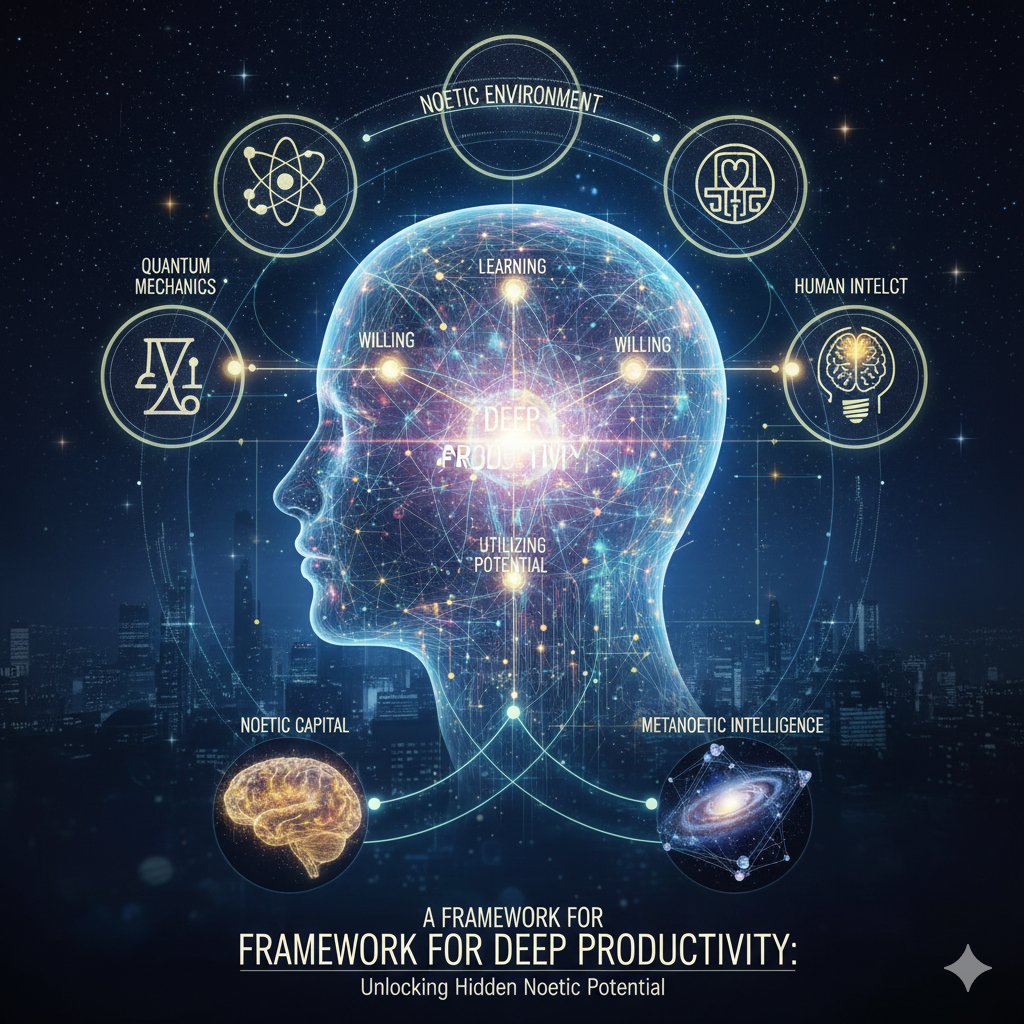
QNM is a theoretical framework to examine and understand practical productive wisdom and intelligence in new lights of quantum relativity. But here, in this article, we shall touch upon the metaphysics of productivity at the outset. It will help promote creation of motivational noetic environments that bridges quantum mechanics, metaphysics, and the study of human intellect. Thus, it will guide learning to promote higher productivity.
Deep productivity is accompanied by deep work (Newport, 2016) which is a norm today to survive the stiff competition that characterise modern digital economies of scale and industrial production frontiers. Deep productivity results from learning, willing, and utilising the power potential latent within us, and understanding the interrelationships among these functional entities.
We shall examine the metaphysical interrelationships between learning, intellect, and human productivity dynamics through all our articles, using the theory of productive wisdom to examine how our noetic components impact productivity.
Unlocking Hidden Noetic Potential
The goal is to unlock human potential, enhance productivity, and inspire creative thinking by understanding the deeper aspects of the “will to action” through mental effort. We also focus on noetic capital—the intangible form of resources which are human intelligence and cognition and metanoetic intelligence, which is a form of intelligence at the crossroads of quantum relativity and human consciousness. The idea and the concept of metanoetic intelligence has been conceived from the foundational work of Hegel’s (1868) “The phenomenology of spirit. The Journal of Speculative Philosophy.” The aim is to analyse how the noetic-perceptive-cognitive aspects influence productivity, economic outcomes, and individual performances. The pursuit of higher productivity using quantum level analysis of the mind and the human willpower can help develop new cognitive tools and technologies that can further enhance the powers of both natural human and artificial intelligence (AI). Virtually, highly aspiring and creative business heads are in hot pursuit for Superintelligence (Bostrom, 2014), which is intelligence beyond the AI and human beings combined. But it would not be possible without deep learning.
On the way toward unlocking higher human noetic potential, it would help create a path to higher learning that meets nobody’s. A new way of productive learning will spur deeper curiosity to acquire knowledge beyond others’ guess. Therefore, it involves deep thinking which is slow but effective in the long run. Deep thinking is a sign of noetic/cogitative strength that accompanies deep analysis and deep inquiries. The comforting effect of this deep toil rests in noetic reward which can further increase one’s zeal for secret knowledge of productive wisdom hitherto uncovered. The book titled “The Life of the Mind” written by Arendt (1981) investigates thinking, willing, and judging which digs a parallel concept to learning, intellect, and productive action. Learning, in this context, refers to knowing or noesis. In fact, Hannah Arendt (1981) investigates the life of a mind in relation to how we think, since thinking is a cognitive function of the mind which is triggered by learning new things. It matters how we think, and how to think about learning well.
How to Seek Wisdom at Work?
Finding wisdom at work is a great way to learn about the work being accomplished which decrees deep search for new meanings… It also leads to noetic discernment—meaning that the mind creates its own path to knowing and learning about how to know more at great depth and distinguish productive from unproductive wisdom. The dawning effect of noetic discernment rests in the depths of study which leads to deep intelligence (DI). Do not confuse this deep intelligence with machine learning and machine intelligence, since human deep intelligence is different from that of AI-driven deep learning. The path to noetic discernment is through knowing the most powerful, secret method of accruing productive wisdom which creates a new path to Hyper Intelligence (HI). This form of intelligence is different from universal intelligence (UI). This knowledge is most secret but it becomes apparent while going down into the great depths of noetic contemplation: reflective wisdom at metaphysical depths which triggers higher human potential. A work much related to this context which is of great value is Bernard Lonergan’s (1992) “Insight”–being a profound work on human cognition, noesis, and the structure of understanding.
Understanding the different forms of deep learning coupled with the philosophy of hyperintelligence (Käfer et.al., 2025) creates the foundations of deep perception (DP). One can only perceive at great depth if one has special talent for deep thinking, deep reflection, and contemplation. But all these traits can be nurtured, and hence, acquirable. According to Stephen R. Covey (2024), these traits can be categorised as productive habits which connect willpower, principles, and disciplined execution. They lead to the discovery of esoteric wisdom which has great power. We must understand the role of human willpower in action that drives one to think and work at extreme deep levels. It creates a noetic depth—which creates a new noetic path.
The foundations of all great works lie in the depth. The foundations of all philosophy is knowledge. The foundations of all science lie in methods and processes. Deep knowing leads to better understanding of the methods and processes, which is a form of deep noetic learning. It is not a meta-scientific concept—but noetic science through deep practice. So, let’s go deeper. Let’s nourish our intellect with deep knowledge and wisdom of practice of productivity. It will help lay the framework for deep productivity.
Going Deeper: Deep Noetics
Science establishes facts that hold on: structures built on scientific grounding are strong and some of these methodological wisdom of practice becomes secret—for this is the wisdom that becomes secret and esoteric—and yet, there’s nothing mysterious about it. The core secrets of knowing, however, lies in thinking effectively about the most efficient ways of doing things: other things like learning, productivity, and creative thinking will follow instinctively.
Hence, seek in the depths of the metaphysics of knowing (noesis). It will bring out great knowledge from the depths. And when you’ve search in the depths, come to the surface with wisdom mined from the depths. The art lies in knowing how to penetrate the depth of knowledge—the depths of contemplation. Powerful ideas remain hidden from the surface at great depths which you must penetrate to unearth their real meanings. It is also liberating for your mind to think freely at great depth. The habit of deep noesis also germinates the seeds of Grit: to nurture perseverance and passion for the pursuit of long term goals (Duckworth et. al., 2007).
Through deep thinking, you’ve already charted out new paths to walk and pursue your way to greater success. Walk in the path you’ve created for yourself. Aspire to do the impossible while facing great adversities on your own path. If you succeed in penetrating the bottom, you’ll come out with great noetic acumen. There are many secrets to unearth from the very bottom. Great achievers know this secret, and they know more: about how to read well to know and understand better. It pertains to deep reading. One can refer to a classic work written by Adler and Doren (1972) on this subject matter: “How to Read a Book.” It will shed more lights on intellectual life (Sertillanges, 1992). Great experts work hard and even know where to search and how to search effectively for great powerful secrets that provide them with the much required noetic foundation of the knowledge that they require.
Conclusion
The digging and mining for hidden knowledge in the depths have always remained a favourite pastime for most ancient and contemporary scholars, Renaissance trendsetters, avant-gardists, creative inventors, poets, philosophers, and scientists. Deep inquiry needs no specific tools but the techniques of reasoning, logic, and cogitation by the power of which it increases our visibility at depth. Deep inquiry necessitates deep reading, and there are techniques that facilitate it. It increases our noetic acumen necessary for deep perception. By developing your ability to see in the depth, you can also increase the power of your noetic imagery. While engaging in deep studies, just mark your way into the depth of understanding.
References:
- Newport, C. (2016). Deep work: Rules for focused success in a distracted world. Hachette UK.
- Covey, S. R. (2024). The 7 habits of highly effective people. Personal Finance Magazine, 2024(527), 8-13.
- Hegel, G. W. F., Brockmeyer, H. C., & Harris, W. T. (1868). The phenomenology of spirit. The Journal of Speculative Philosophy, 2(3), 165-171.
- Lonergan, B. (1992). Insight, Volume 3 (Vol. 3). University of Toronto Press.
- Arendt, H. (1981). The life of the mind: The groundbreaking investigation on how we think. HMH.
- Duckworth, A. L., Peterson, C., Matthews, M. D., & Kelly, D. R. (2007). Grit: perseverance and passion for long-term goals. Journal of personality and social psychology, 92(6), 1087.
- Nick, Bostrom. “Superintelligence: Paths, dangers, strategies.” Strategies (2014).
- Adler, M. J., & Van Doren, C. (1972). How to read a book. Simon and Schuster.
- Sertillanges, A. G. (1992). The intellectual life. CUA Press.
- Daniel Käfer, Jacob Bock Axelsen, and Lars Tvede. (2025). Hyperintelligence: How the Universe Engineers Its Own Mind. John Wiley & Sons Inc.