
A model of human productive efficiency
By SIDHARTA CHATTERJEE
February 13, 2026
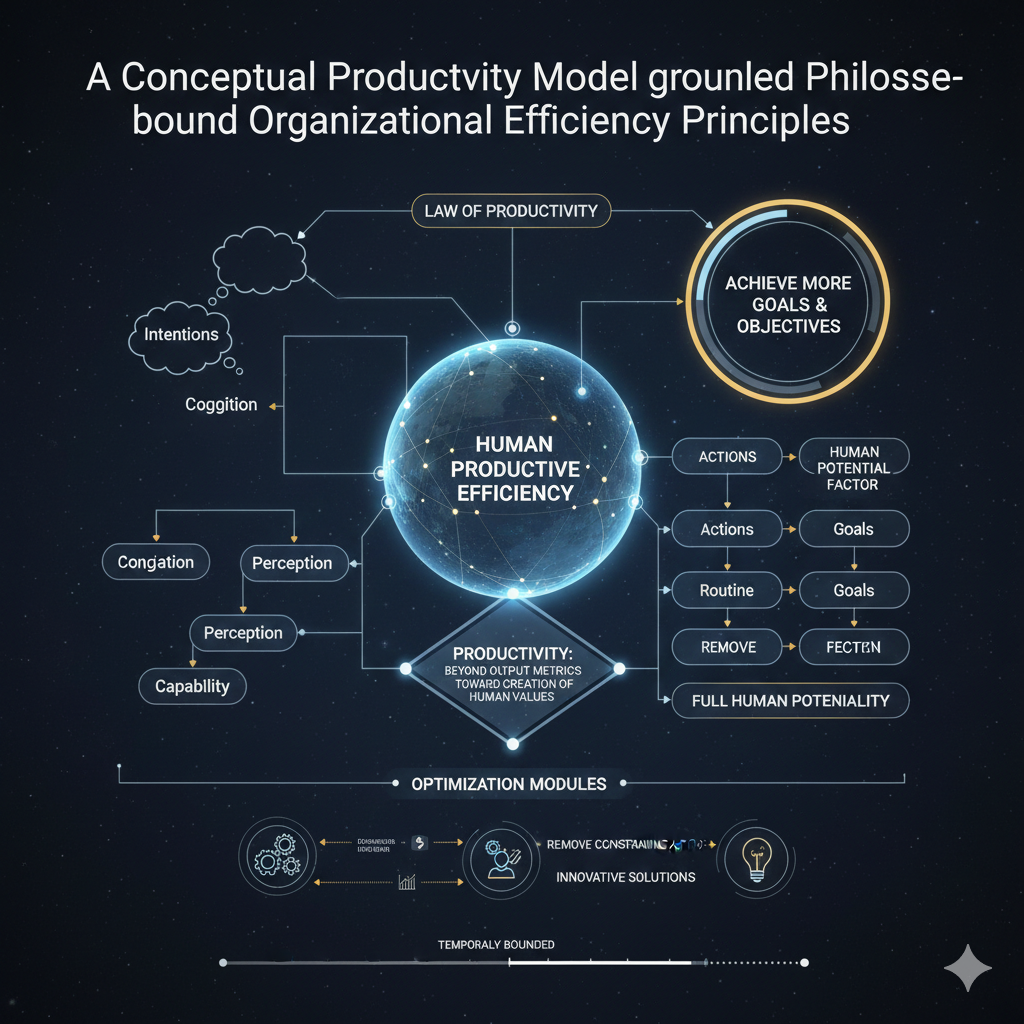
The prime message of this articles is, to do more with your productive capability, to utilize more of your productive potentiality. That means having more potential to achieve more goals and objectives. It brings the principle of efficiency to the forefront.
This article moves beyond conventional economic interpretations of productivity and productive efficiency into the formal domain of constructive reasoning of and the criticism of productivity—which is beyond a simple reductionist approach of output metrics toward creation of human values. The dynamic model so discussed incorporates actions, routine, goals, and human potential factor. The conventional thinking is that, productivity is a functioning of metaphysical factors that include intention, cognition, perception, and capability, all of which are formalized into a “Law of Productivity.”
The human productive capacity is temporally bounded and constrained by limiting factors, thus requiring innovative solutions and methods to remove the constraining factors to help realize full human productive potentiality.
Today, productivity has become an important economic imperative and a cultural ideology for the corporate and business organizations. To secure best performance from individuals, hence, it requires optimization of modules using innovative tools of productivity. We do not treat human productivity simply as an end in itself, but as a means to achieving higher ends through flourishing of productive capabilities.
Metaphysics of Human Productivity
The metaphysical aspects of productivity are an inquisitive investigation into the structure, essence, and principles that govern productivity. It is necessary to illuminate our mind about what productivity is, and what it is not, and what conditions promote it, what constraints hinder it. Finally, how all these relate to organisational dynamics.
We posit that productivity is both teleological and technical. Teleological—because it is driven by goals, and technical, because it is driven by methods and principles. But both these are limited by learning and information, and constrained by systemic factors, e.g., obstacles, errors, etc. We also posit that human productivity is shaped by a set of dynamic factors, which include rules, guidelines, actions, routines, effort and principles that are in line with modern theories of productivity. But beyond these, we also posit that it is set by human cognitive potential factors that are constitutional elements designed to help adapt human beings continuously to higher levels of activities. Hence, it incorporates work and innovation.
Understanding the Sense of the Symbolic and Semantic Representation of Productivity
Productivity is a symbol of value and purpose. Products and services have both economic function and use value, since high productivity is linked to success and mastery. The social perception of productivity, is, however, organizational and economic in nature. But we add another dimension to it: Noetic dimension. This has important implications. It goes beyond current perspective on productivity driven by AI tools and as well as AI productivity itself.
Semantic Construct
To give it a semantic construct, which is embedded in meaning, purposeful actions, goals and routines, it relates to process-oriented perspective of human and organizational productivity. All these factors create a vicious cycle of performance, output, and perception of value.
Human Capacity Construct
Productivity is limited by the human capacity to think, act, and do purposeful activities. But it is vulnerable and fragile, i.e., it is prone to impairment due to faulty methods, errors, procrastination, outdated systems of working, inefficient routines, psychological and cognitive barriers and constraints, etc. The biggest problem is that, we often commit offences against ourselves: procrastination. This hinders our productive potential.
Human effort is now animated by AI-driven tools that excel in speed and accuracy. Performance is now perceived as a sense of efficacy. But if we want to harness the full potential which we have within us, it needs motivation and drive to drive out procrastination. Hence, we are in search of more efficient functional model of human productivity—which is continuously being challenged by the efficacy of AI productivity. However, it must be considered as well that productivity of a system is fixed and finite and determined relative to a standard of reference, i.e., higher productive system in existence.
It may be possible to exceed the capacity but not without further adaptation or evolution in systems, since without adequate transformative change, it leads to diminishing returns, poor performance or inefficiency.
Conclusion
In a nutshell, productivity revolves around actions, routines, and goals. This pertains to clarity in defining goals and objectives, effective and adaptable routines, timely actions, and minimizing procedural errors. There are as many other factors that determine human productive efficiency, but the reason why some organisations are vastly more productive than others are tied to these factors, alongside expertise and skill development (upskilling), discipline, strategy execution, and consistency in maintaining the quality of production of goods and services. Optimal interplay of these determinants helps boost human potential to higher levels.
References:
- Chatterjee, S. (2025). Motivations in the Productive Space: Overcoming Mental Fatigue and Cognitive Constraints.
- Chatterjee, S. (2025). Productivity Maximization and Human Productive Potential.
- Chatterjee, S. (2025). The Foundations of Productive Potential.