
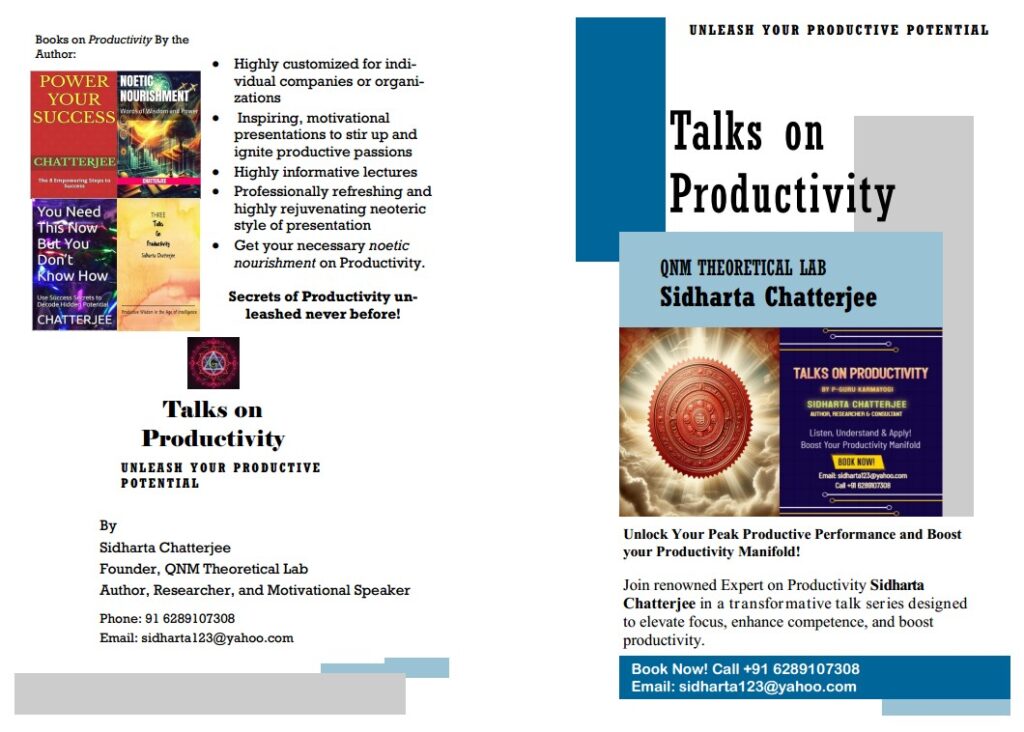
Talks on Productivity
Duration & Structure of Talks
Total Session Package: 6 Lectures (3+3, 30 minutes each) in 2 days
15 minutes Question Hr. after each session (30 mins + 15 mins = 45 mins)
Who will benefit from the Talks? The Target Audience:
- Managers
- Leadership teams
- Mid-level employees
- Startups
- Growing organizations
- Performance-driven teams
- Learning Organizations
Book Your Talk Today!
Our consultancy services, hence offer unique opportunities for the learners, managers, and mid level employees, and for those who aspire to achieve greater success and power by utilizing their inner potential more efficiently. Call today to book your consulting slot, and get the best out of our expertise in helping you to grow and become more productive.
Note: Introductory corporate partnership pricing available upon request.
Secrets of Human Potential & Productivity unleashed never before!
Talks on Productivity & Consultation Schedule
Details:
To book your Talk, send us an email.
All sessions are customizable according to industry, team structure, and organizational goals.
*Note: Talk topics on Productivity are highly customized and aligned to different sectors as per requirements of the host organizations.
Talk Session
SIDHARTA CHATTERJEE
Session I
“This is the age of productive secrets and productivity hacks!”
If you want to elevate yourself to a higher productivity level, you have to have an aptitude for learning. With AI redefining the productive landscapes of every domain, you’ll need to expand your noetic horizon to explore more productive possibilities. This will invariably boost your productive potential and align you better with AI systems. What you need to do could be enumerated as follows:
- Power your learning with productive wisdom: learning empowers our productive capabilities
- Understand the role of productive forces in action: this will help you in accomplishing your goals and objectives
- Strive to perform better to become one of the best: it requires some secret recipes and wisdom of action
Astrologers strive to excel in predicting fortunes for others. The point is, how well one predicts the future with precision. What does scientists do? They design real models that produce outcomes. How well you can design a great, productive outcome? Statisticians and probability theorists keep struggling hard that improve the predictive powers of their models. They all need information, but the scientists generate information and data from experiments which statisticians utilise to obtain precision in prediction. The point is,
How well you can design a great outcome?
Data speaks like nothing, and facts are always better than fiction. Science does it exactly so: improve the predictive powers of a model, solve problems, and design systems that produce accurate responses. Data is more relevant today, for both individuals and businesses, and for governments as well, since all utilise data to make informed strategic decisions aimed at improving organisational productivity.
For example, there are various aspects of organisational productiveness—those related to R&D, operational frontiers, sales, marketing, investments, acquisition, branding, production, pricing—all of which require precise information and data to make correct decisions that matter. It demands the power of productive learning, training, and practice, since all these reinforce the strength of organisational productiveness. It also shapes the effects of learning on organisational performance in terms of economic outcomes.
Results are what that really matters today—outcomes, positive outcomes of course—, and productivity is all that counts. This elucidates thedynamics of learning-productivity-capability cycle conceived by Chatterjee and Samanta (2025).
Session II
“Be endowed with the power of great productivity.”
Productivity can be realised only when individuals act and become proactive, that they have goals to achieve and targets to realise. It is necessary to take the initiative first of all. Individuals can start doing, on a regular basis, one thing at a time and make it a routine habit of doing it on a regular basis. Whether it be a 1-2-3 or 2-3-2 rule or any other is less important. Routine practice builds up a productive culture. As human beings, we are rational agents and our rational capabilities are enabler of productivity. It allows us to become creative and innovative. Innovation is the key to survival in today’s competitive world.
Learning strengthens the bond between intellect and productivity. The will to act is a powerful motive force. It is a productive force in dynamic action. Organisational strategic decision-making aimed at enhancing workforce productivity stresses on the efficiency of the agents in accomplishing certain tasks. It defines how productive someone is, and how much more productive one can become. Here, our intellectual capabilities like reasoning, thinking, and problem solving function as productive abilities.
Productivity is reflected in the society in a variety of ways. Without citing specific examples, it would be futile to explain or examine the socioeconomic aspects of human productivity. And yet, examples are abound that don’t need citations.
As I have mentioned above, “human rationality”is a creative capacity; i.e., an enabler. The point to consider is that, how much rational we can become in order to exploit the full potentiality latent within all of us in order to become highly productive individuals.
Since learning is a necessary factor for accomplishing cognitive actions, it is also the prime factor which amplifies intellectual capability, thereby reinforcing productivity. It is one of the key enablers of both Noetic and Anoetic (productivity) productivity.
Strategic decisions are taken in almost all organisations with regard to the promotion of workforce activities in order to generate productive outcomes. Therefore, variations in learning and intellectual developments contribute to fluctuations in economic outputs and organisational performance at the micro-level.
“The reason being that, learning, intellect, and production functions are closely knitted and interconnected, where productivity is rooted in human rational capabilities, as mentioned overhead. Learning strengthens the human intellect, and when it is reinforced, the bonds become stronger.”
Changes in organisation learning patterns and cognitive developments of the employees, however, either positively or negatively affect organisational performance, causing variations in efforts devoted towards achievement of an organisation’s goals and objectives. All these are essential for making sound and effective decisions, and it is learning that informs organisational decision-making, this being true for both hominids and AI-driven machines. With full potentiality unleashed, individuals can aspire do their best on the fields, ramp, at schools, or at their workplaces, without doubt.
References:
Chatterjee, S., & Samanta, M. (2025). Social Noetics and the Economics of Productivity.
https://www.preprints.org/frontend/manuscript/9d90cdd575990ece7149c5e9f254dc32/download_pub